

Selective attention is the process by which our brains focus on a subset of available stimuli, typically those most relevant to our current goals, while filtering out everything else. It’s what lets you follow a conversation at a crowded party or zero in on your character’s health bar in a video game while the rest of the screen erupts in chaos. Our brains are not passive receivers of information; they are active filters, continuously deciding what matters and what doesn’t.
This filtering has real consequences for both User Experience and Player Experience. In UX, it surfaces in phenomena like banner blindness, where users unconsciously ignore content that looks like advertising, and change blindness, where significant interface updates go unnoticed because nothing draws the eye to them. Board games face the same challenge. A table mid-game can be covered in cards, tokens, boards, dice, and miniatures, and a player’s attention will naturally narrow toward whatever serves their immediate goal. The designer’s job is to work with this tendency, ensuring that critical information is easy to find and hard to miss.
Gloomhaven
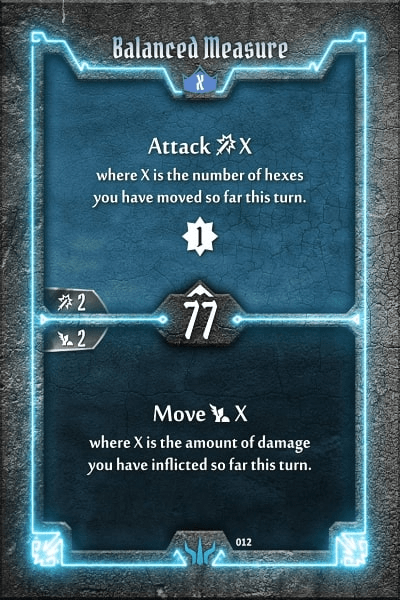
Gloomhaven manages selective attention by limiting what players can see in the first place. Cards are held privately, so each player’s focus naturally and correctly lands on what they can control: their own hand. Not to mention that if hands were visible to all players, someone would likely start telling everyone exactly what to do. When cards are revealed for initiative, the bold number printed prominently is the only thing that matters at that moment, and the layout makes it easy to scan. The design doesn’t fight the brain’s tendency to filter; it channels it toward exactly the right information at the right time.
Wingspan

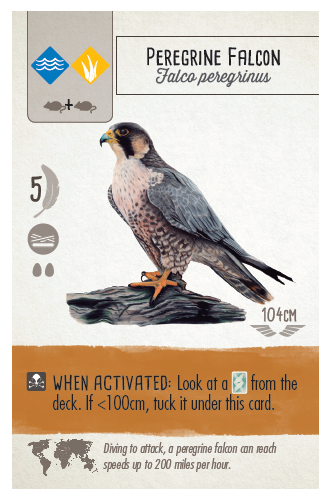
Wingspan’s player board structures attention across phases of the game by organizing the three habitats into clearly color-coded sections. When a player takes an action, their eyes go to the relevant section, and the design supports that narrowing. Notice that the card has 6 distinct regions. 4 of these fall into the background. While two other regions (the top left and the colored row across the bottom) take visual priority. It is amazing how the brain can easily chunk these things and focus on the relevant region at the appropriate time. The visual weight and hierarchy of the content supports this by pushing much of the content to the background.
Pandemic
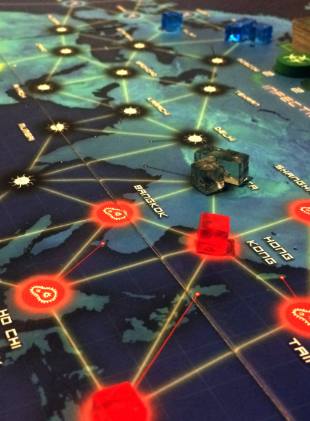
Pandemic is a cooperative game where selective attention can quietly kill the team. The board communicates threats through disease cubes. Simple, visible, and countable. The problem is that players naturally focus on their own regions, filtering the board down to their local areas while a three-cube city develops unnoticed across the map. Or another way this happens is if a player is only focusing on one color, they can easily miss the others. Experienced players learn to periodically force a full-board scan, essentially overriding their brains’ filtering tendency through deliberate habit. It’s an interesting example of a game that requires players to actively manage their own selective attention as a core cooperative skill.
Azul
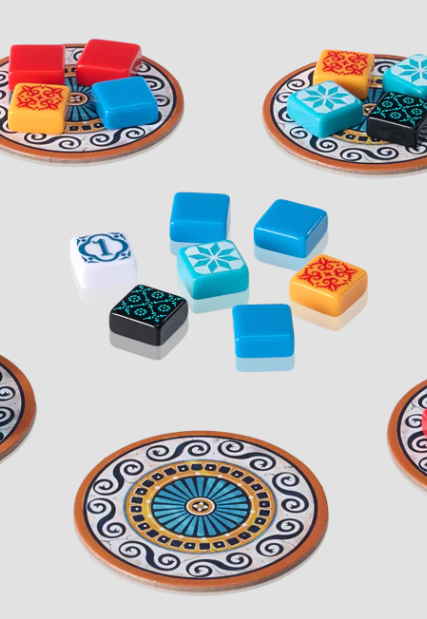
Azul structures attention through physical space and color. The discs in the middle enable players to focus on a single location, from which they will be selecting tiles. Alternatively, if a player is considering a given color, you can almost instantly scan the playing field to identify options. I call this the tootsie roll effect (look up the old comercials hear the jingle). This is when we decide to look for X, and then all we see is X. Think about when you sort a pile of coins. If you are looking to gather all the quarters, you immediately see them and nothing else. The brain is a neat thing. And a game like Azul elegantly works with our natural tendencies.
Conclusion
Selective attention is not a flaw, it’s a feature. Without it, we’d be overwhelmed by the volume of information present in any complex environment. But it does mean designers cannot assume players will notice everything on the table. The examples above show the range of approaches available: structuring what information is visible, clustering it spatially, using the physical layout of the table to create attentional rhythm, or treating attention management itself as a gameplay skill. The key insight is that player attention will always be selective, so the question is whether the design is guiding that filtering toward good decisions or leaving it to chance.
