
An important aspect of understandability in board games is clearly communicating progress to the players. If players can’t track progress throughout the experience, it can leave them feeling like they are getting nowhere. Steady progress toward the end goal needs to be shown to keep players engaged. Games that lack progress indicators or even totally hide the results until the end can have a serious lag in the middle. Some games do pull this off, but typically, it is done in relatively small and short games. Let’s consider some ways board games do this and see what impact it might have on the player experience.
Scoring tracks – Physical markers moving around a board or along a numbered track showing relative positions and point totals at a glance
Progress tracks – Linear paths showing advancement through phases, eras, or stages of the game (like tech trees or development tracks)
Tableau building – Cards or tiles played in front of players that create an expanding display of achievements and capabilities
Board state changes – Completed buildings, claimed territories, or filled spaces that show what’s been accomplished.
Victory point counters – Direct numerical representation of progress toward the win condition
Level markers – Numbers showing advancement in various categories (strength, technology, economy)
Turn/round counters – Indicators showing how far into the game you are
Completed sections – Finished areas of player boards or game boards that visually show what’s done
Network building – Connected routes, chains, or territories that demonstrate expansion
Filled patterns – Completed rows, columns, or shapes that provide visual satisfaction of progress
Relative positioning – Being ahead or behind other players on tracks or in resources
New abilities – Gaining access to previously unavailable actions or powers
Component unlocking – Opening new boxes, revealing new cards, or accessing new game areas (especially in legacy games)
Milestone rewards – Bonuses triggered when reaching specific thresholds
Engine building – Actions becoming more powerful or efficient, showing your growing capability
Cascading effects – Single actions triggering multiple benefits, demonstrating system synergies
Decreasing costs – Things becoming cheaper or easier, showing advancement
Depletion – Supply piles running low, indicating the game is progressing toward the end
Phase transitions – Moving from early game to mid game to end game with visible changes
Clock mechanisms – Physical or conceptual timers showing time remaining
Some examples
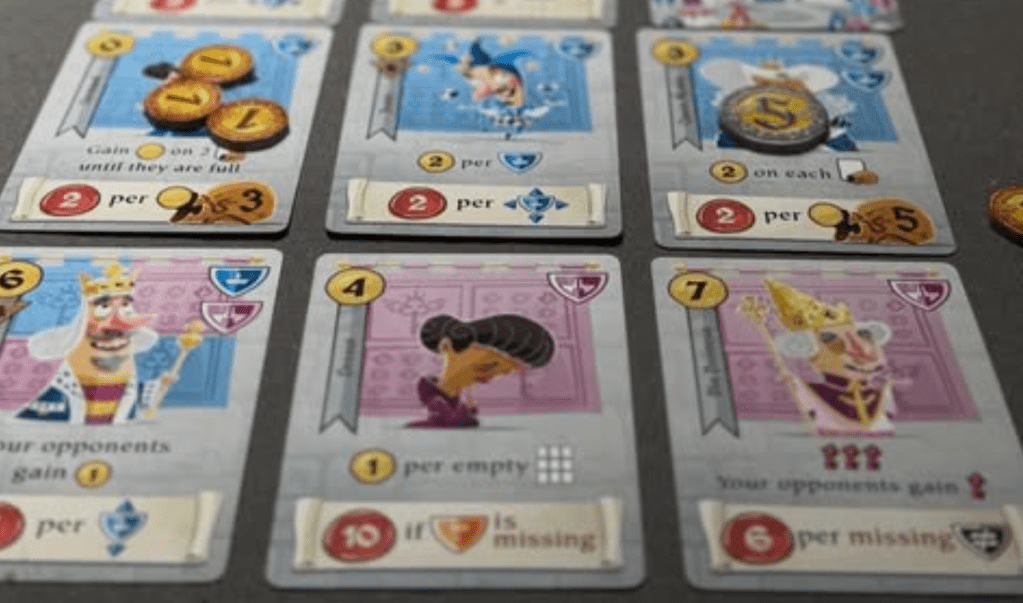
I recently played the game Castle Combo, and it uses a clear and simple visual indicator. On each of your turns, you gain a card and place it into a 3×3 grid in front of you. You will get exactly 9 turns and 9 cards. Game progress is clearly displayed in front of the player.
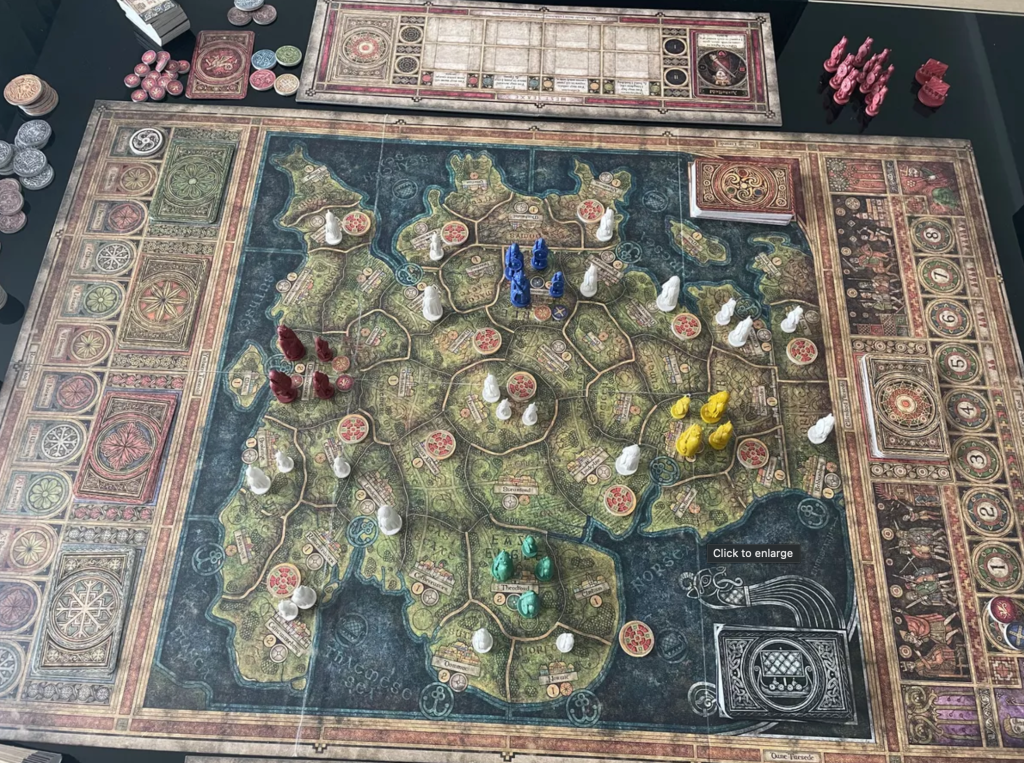
Another game that does this well is Bretwalda. On the sides of the board are two tracks. The first tracks progress through the seasons of the game. Once you go through all 4 seasons 3 times, the game is over (though it can finish earlier). In this way, players can see how much progress is made. The second track on the right side tracks the current victory points everyone has. In this game, you get points from assorted things, and it isn’t always clear who is winning. On top of this, you can easily lose points. This simple track shows the number each person has. On top of that, it highlights the special conditions that apply when a player reaches 7 or 8 points and triggers the endgame.
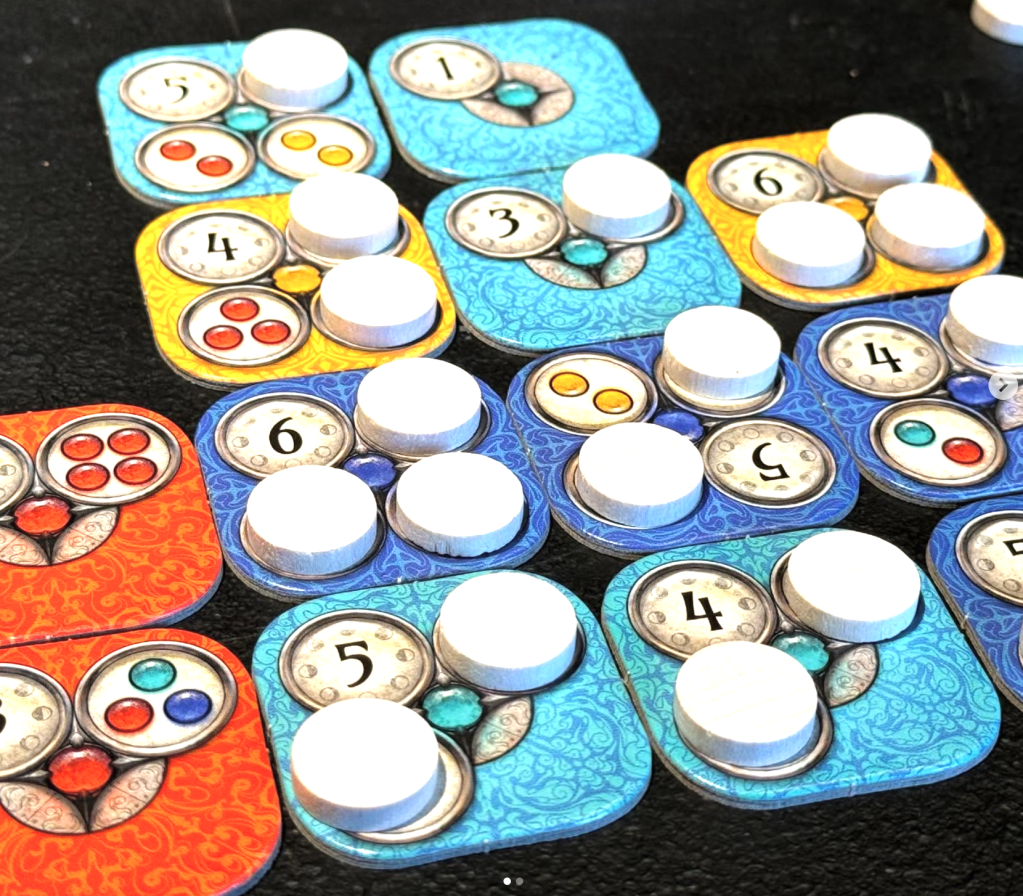
In Nova Luna the game ends when a player has used up all of their tokens (the white discs). This is easily observed as you scan the table. The tokens move from their supply to the tiles you are acquiring. The score is not tracked, but you can infer the scoring based on how many discs each player has placed. Though this is not really super accurate because harder tiles, scoring more points, might be finished in large batches later in the game. Even still, it gives a sense of progress to the game and clearly alerts players to the endgame state.
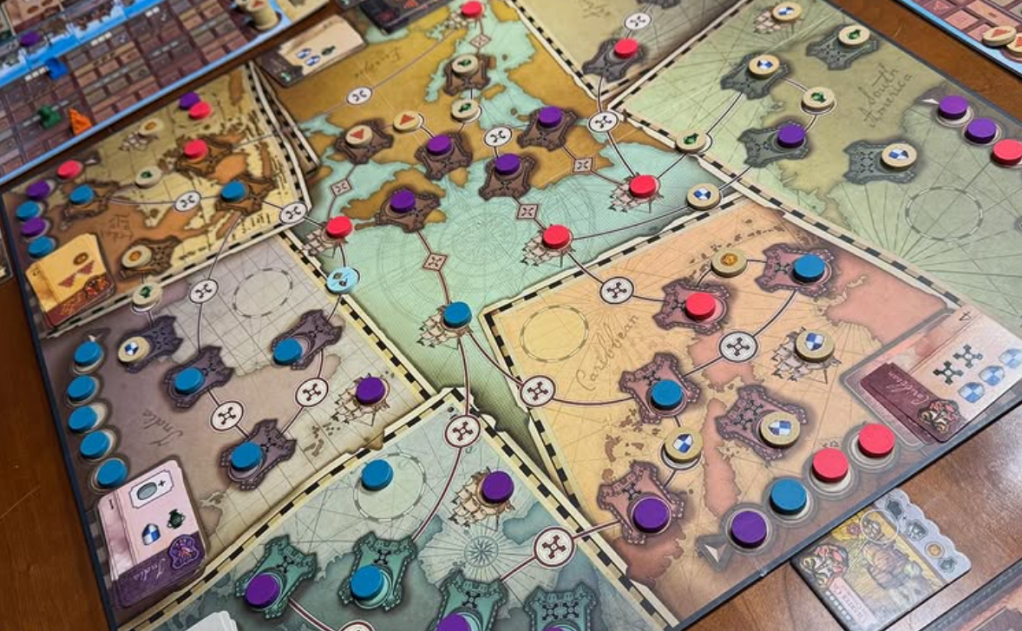
In Endeavor: Age of Sail, players get a new building each round. The end of the game occurs when everyone’s board is full. In this way, the progress of the game is clearly called out. However, much like in Nova Luna, the actual score is not tracked. As such, it can be difficult to gauge who is winning. It is interesting how this prevents players from ganging up on the current leader. In my game group, when we play this game, it’s 100% about optimizing each action you take…and not so much about figuring out the leader and trying to hinder them.
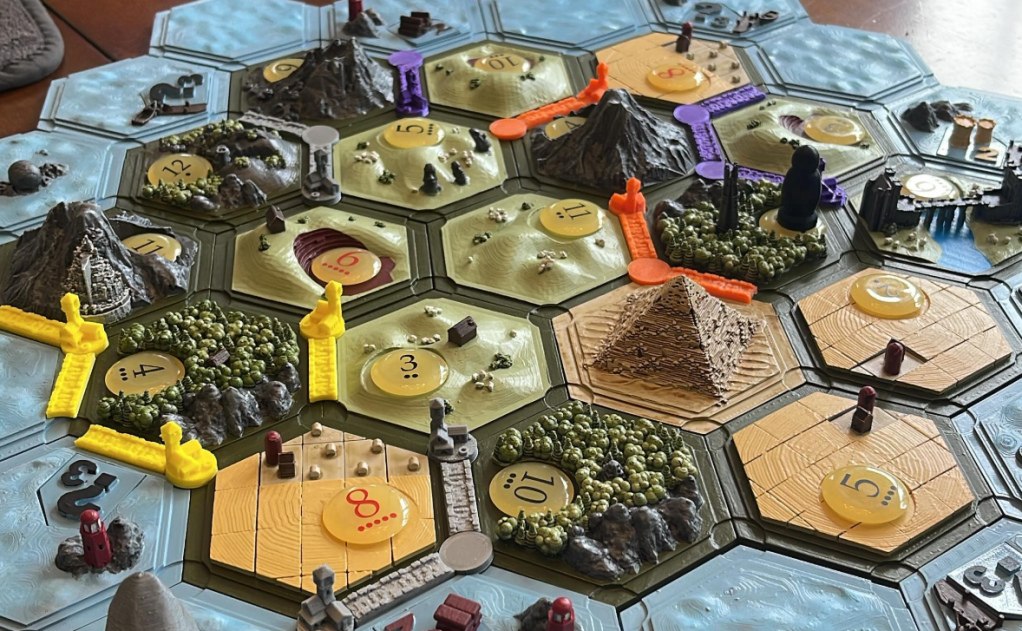
Settlers of Catan is a classic game that is obviously very well regarded. However, it does not communicate game progress as effectively as it could. Players definitely sense the game is moving forward as the board fills with buildings and resource production ramps up. However, scores are not displayed or calculated anywhere. Players must frequently ask and add up how everyone is doing. A simple track showing current scores would eliminate this problem. In contrast to Endeavor: Age of Sail, Catan is a game where you definitely avoid helping the leader, and knowing who that is can be critical.
Conclusion
As we design games, it is important to think about the experience players will have moving through the game from start to finish. It is important that players understand where they are in the game. One thing to observe during play testing is if players are accurately interpreting the game state. This is equal parts observation and asking player questions during and after the game. It is interesting to consider how understanding progress in a game can lead us to creating stronger player experiences.
