

Grouping is a fundamental design principle where related elements are visually clustered together to help users quickly understand relationships and navigate information. Rather than scattering related content across a layout, effective grouping uses proximity, containers, color, and spacing to create clear visual chunks that the brain processes as unified concepts. This principle reduces cognitive load by organizing information into meaningful categories that players can scan and comprehend without parsing every individual element separately.
In board game design, grouping becomes essential when cards, boards, or player mats contain multiple pieces of information that serve different purposes. A card might display costs, effects, victory points, timing information, and thematic text—each serving a distinct function during gameplay. Without thoughtful grouping, players waste mental energy determining which information matters for their current decision and where to find it. Well-designed grouping creates visual hierarchies that naturally guide the player to relevant information.
The challenge for game designers is balancing information density with clarity. Complex games often require substantial information on components, but simply cramming everything together creates visual chaos. Strategic grouping organizes this complexity into digestible sections, using visual boundaries and consistent positioning to create predictable information architecture. When players know that costs always appear in one location, effects in another, and requirements in a third, they develop efficient scanning patterns that accelerate gameplay and reduce rulebook references.
Dune Imperium

Dune Imperium’s cards demonstrate excellent information grouping through clearly defined zones that serve distinct gameplay functions. Each card is divided into three primary sections: the top area shows the card’s agent action (which correspond to the actions your allowed to take), the middle reveals the card cost and any requirements, and the bottom displays the reveal effect (what happens when you draw it as income). This vertical separation creates predictable information architecture where players know exactly where to look based on their current gameplay context.
Heat
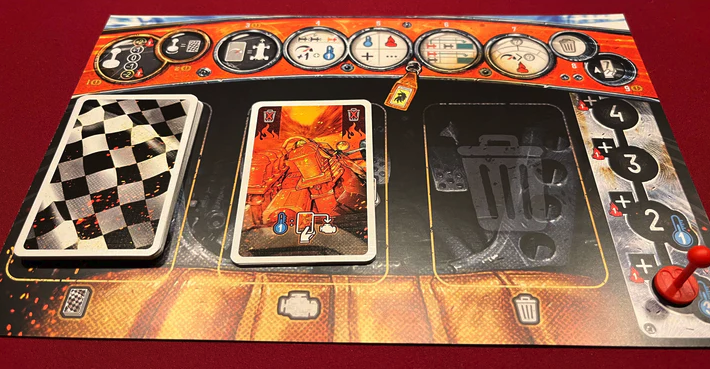
Heat: Pedal to the Metal uses grouping on its player dashboard to organize the systems players must manage during the game. The dashboard divides into clear functional zones: gear tracking on the right side, card locations (there are 3 distinct locations), and a turn reference across the top. This grouping ensures players can easily interact with the key aspects of the game.
Ark Nova

Ark Nova’s cards demonstrate information grouping in a game with dense, complex card effects. Each card divides into distinct zones that separate different types of information: the top banner shows the card name and category icons, the left side displays costs and requirements in a vertical strip, the main card body contains the effect text and thematic elements, and a separate section shows conservation points and appeal values. This multi-zone approach prevents information overload by creating clear visual boundaries between functional categories. To be clear, the cards are very dense with information, but thanks to grouping they are significantly easier to understand.
Conclusion
Effective grouping transforms potentially overwhelming information into navigable, scannable layouts that support efficient gameplay. By clustering related elements together and separating functionally distinct information into clear zones, designers create predictable information architecture that players internalize quickly. You don’t simply want to shove card data into the corners, instead you want to group it into logical zones that streamline play.
