
Working memory is like a mental workspace that allows us to hold onto information for short periods while we use it to complete tasks, such as solving problems or making decisions. It helps us juggle different pieces of information at once, enabling us to think and reason effectively in everyday situations.
Research shows that the average person can hang onto 4-7 chunks of information at once. The simplest example of what this means is the typical phone number. Take the number (314) 867-5309. This is 10 digits total, but it’s broken into 3 distinct chunks. This is not by accident. This was done to help us chunk the number and to be able to remember it.
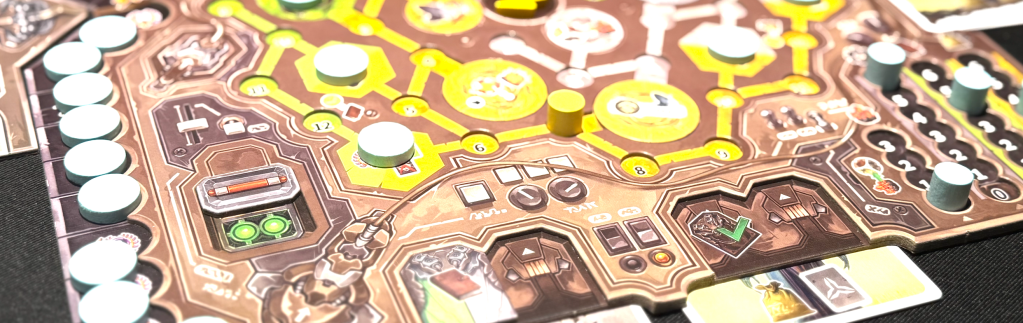
The game Revive knows that you can only store so many things in your working memory and provides a tool to help with this problem. In Revive, you have a small card showing all the actions you can take. When it’s your turn, the previous player passes you two blocks. These are your actions for the turn. You place a block onto your card to indicate which action you are taking. Since this is an engine-building game, each action can lead to a chain of numerous events. The cubes help you track this. After doing one really big, eventful action, it can feel like your turn is over, or maybe it isn’t? This is why those little blocks are so helpful. They help you to track how many actions you can take. By the time you finish a complex action, your working memory has filled up and pushed out prior information, like how many actions you have taken.

To avoid problems with working memory, watch and listen to playtesters. The things they repeatedly mess up, forget how to do, or lose track of are all signs that working memory is being overloaded. In those cases, look for supports, like the card with blocks, that you can create to help players track and recall things without using their memory.
