
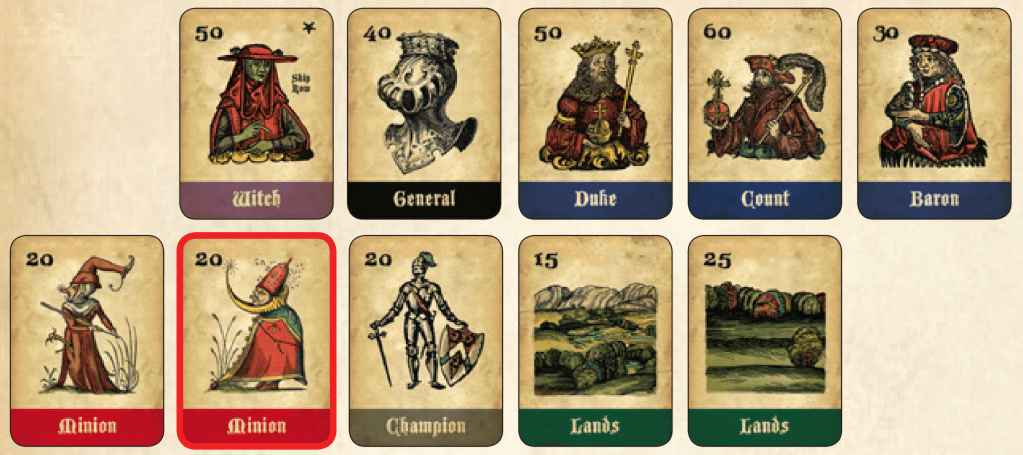
It should come as no surprise that the rule book is a key aspect of player experience. And within that, it makes sense that the book should be clear and easy to understand. If we can’t understand the rule book, how will we ever play the game? The rule book is the first line of defense for a good player experience.
I don’t really care for talking extensively about a design in a negative light, but it does feel like the best way to highlight this metric. So it is with great humility that I will break down aspects of a rule book that simply fails the reader. The first ever game I backed on Kickstarter was called Castles. I was intrigued because the designer was from my hometown. When I received the game, I was super excited. It was small and really beautifully executed. I eagerly jumped into the rules. But the more I read, the more confused I was.
This brings up an important lesson from the world of UX design. Users of a system will most often blame themselves for not being successful in using a system. They will say things like “I should have known how to do that,” but the reality is that it’s not their fault; it’s the designer’s fault. Such is the case with rules. At first, when I read this rule book, I blamed myself, like I wasn’t clever enough to get it. But the more times I read it, the less I knew how to play. Eventually, I realized the rule book was rubbish. As it turns out, I was not alone. Many others have found the rules to be equally useless. But what exactly made it so bad?
I invite you to read through it. It’s relatively short, and if you go in knowing it’s bad you won’t slow down to blame yourself. Download the PDF here.
So where did the book go wrong?
Starting in the middle
The rule book kind of starts in the middle, skipping over all the preliminary stuff we are used to seeing. This creates a super weird rhythm to the rules right from the start. We don’t get introduced to the world, or even get an overview of the way the game works. Also, there isn’t a component list, which could help the reader get oriented to the game.
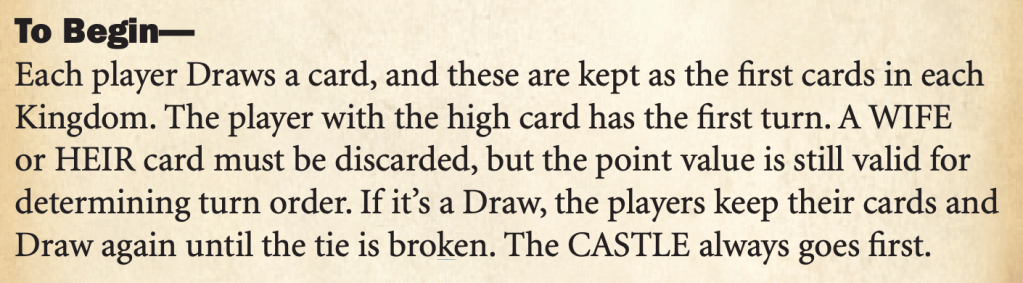
The actual setup instructions don’t come until page 5 after all the cards and actions are explained. On top of this, its not even called “setup,” but “To Begin.” Which is super confusing. So we basically don’t hear how to start the game until long after it has attempted to teach us the game.
Undefined terms
The rules use the words stack, columns and piles, but never really explains what they are. I imagine I know what a column and a pile are. But the way the rules talk about a “stack” I sometimes think its a column. I wish the rules had just used a visual to say here is what the terms are.

Later, the rules say to “fan out” from the center. But this is the only time this is ever mentioned. How do we determine the center? I am guessing it’s the sides, but which one? Its super vague and seems like it could be interpreted in multiple ways.

Terms defined after they are used
Key terms like blocking, danglers and move are not introduced as a formal term until the end of the book. It should not be using a term before it’s defined. The order in which things are introduced truly matters.
Not only is the term “danglers” defined after it is used many times, its definition isn’t even complete. There are additional conditions scattered throughout the rules that specify when various things become danglers.

Overloaded paragraphs
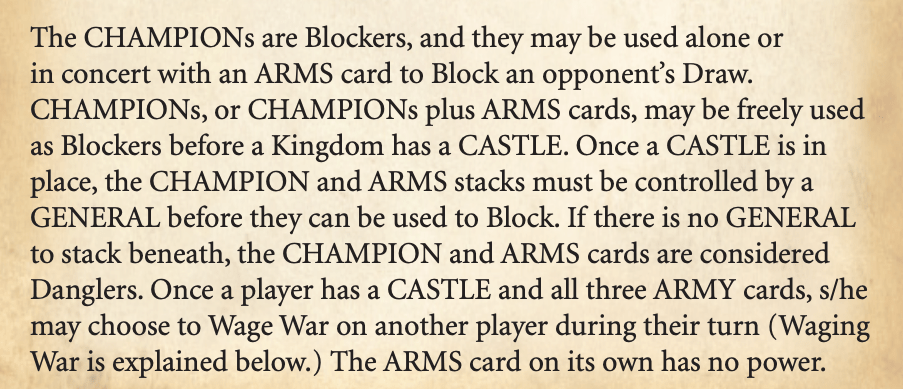
Many of the paragraphs in the book are way overloaded. That is to say that nearly every sentence is a rule that needs more explanation. So in some cases a whole paragraph is needed for every sentence! I read a paragraph like the one below and when I am done I am not even sure what I just read.
Inconsistent structure
The structure of the book is very inconsistent. In one case, there is an asterisk. At the bottom of the page, it seems like they are explaining the asterisk. And yet, it’s just describing another action. Couldn’t there just have been an action to play a wizard card? I have no idea how it’s saying you can play two wizard cards; I have studied it for far too long and can’t sort it out. But wait! Action #5 is to play a wizard card. This chaos totally erodes trust in the book right from the first page.
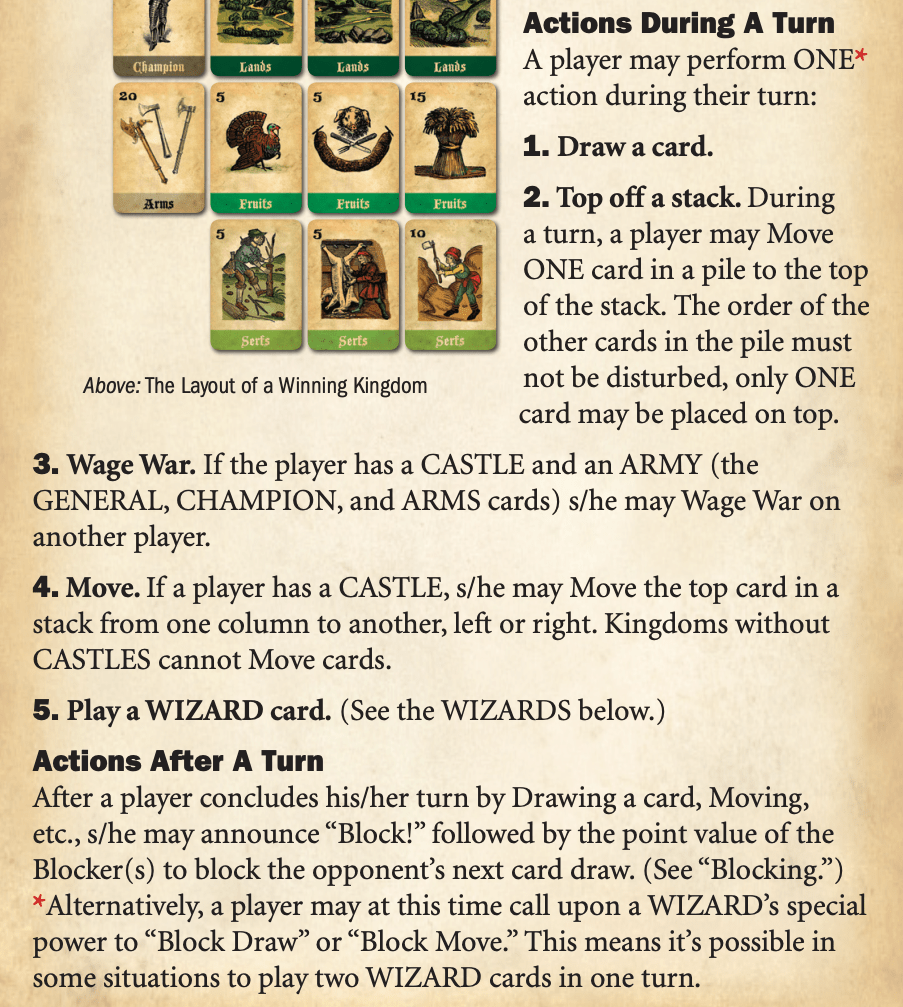
Wait, how do you win?
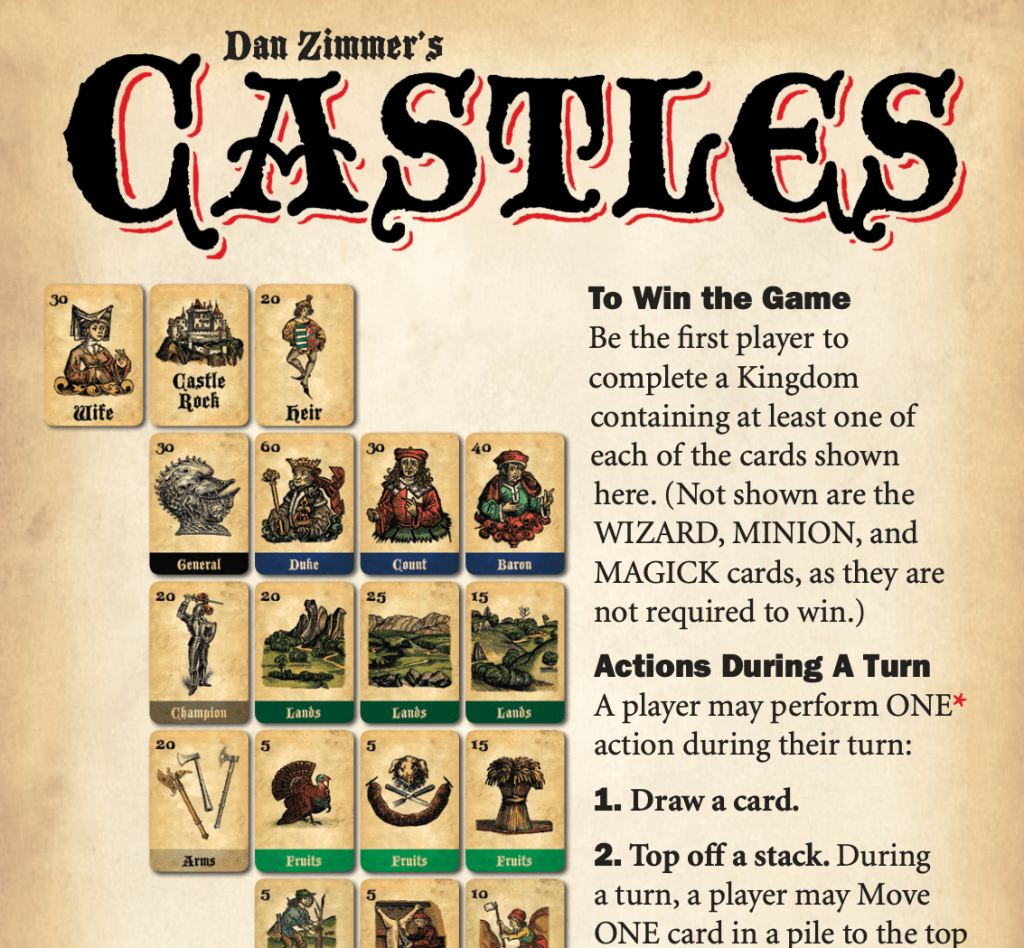
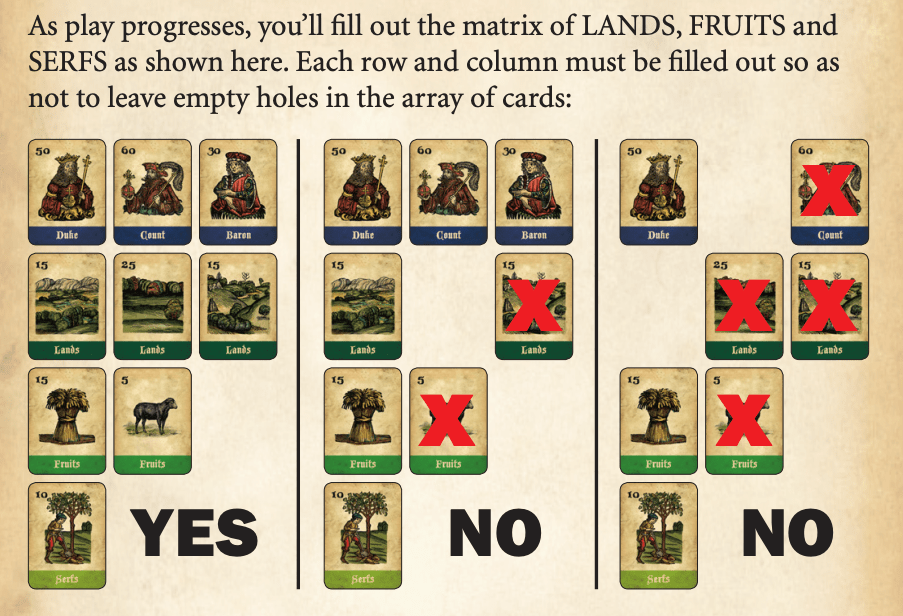
The first thing in the rules book is how to win the game, which you would think at least that would be clear. However, there are special conditions for winning that are peppered throughout the rule book. In particular, it appears that you have to have the cards in this exact configuration, though the rules never come out and say just that. The caption on the sample does say this, but it’s not clear that it literally has to be this format.
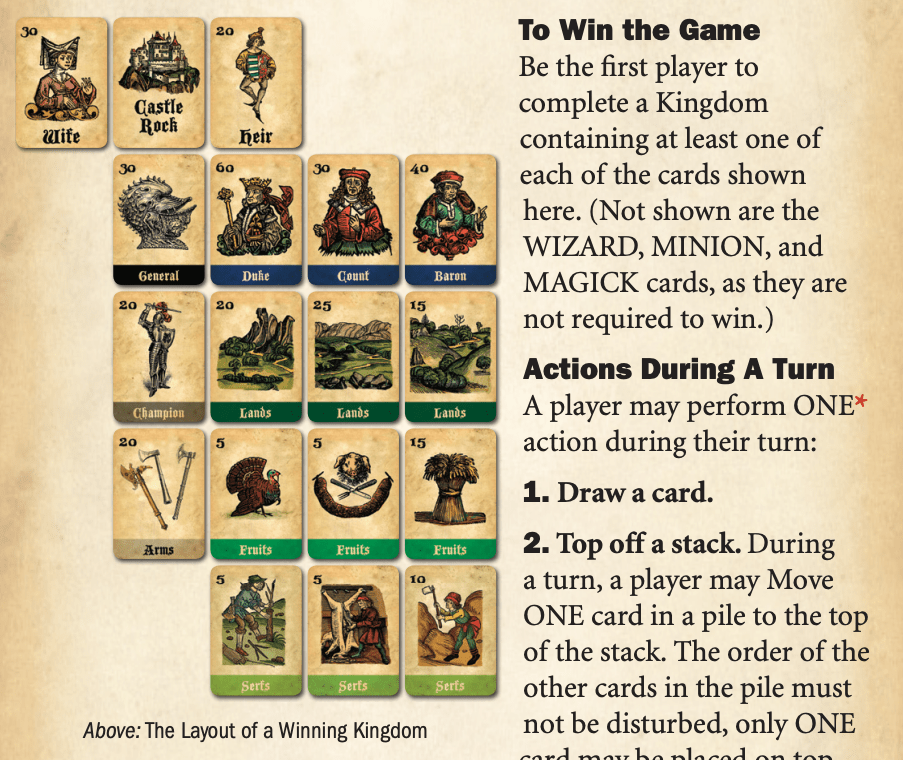
Later, it mentions that the Duke, Count, and Baron must be arranged in the proper order.
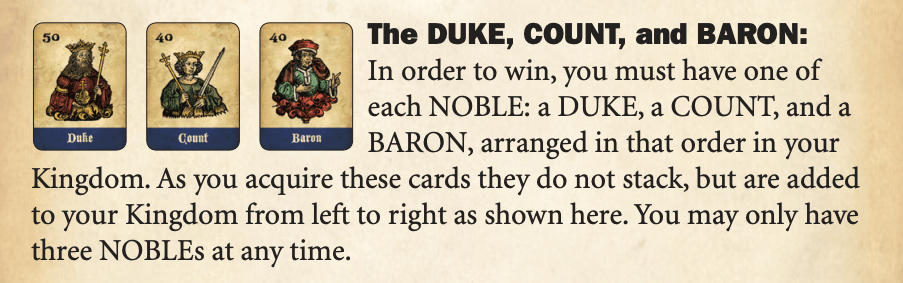
And then later, we get a similar detail about the lands, fruits, and serfs.
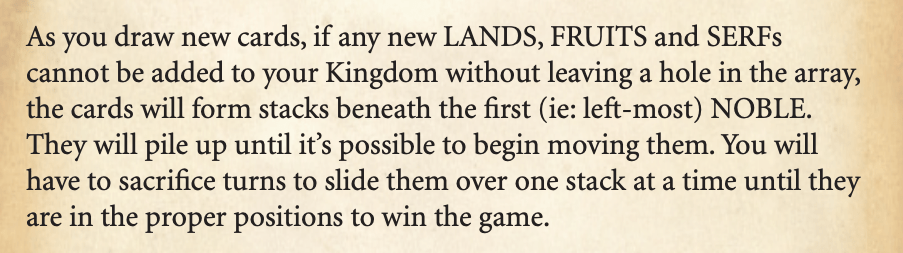
If all of these specific configurations are required, it will be a nightmare trying to sort out the win condition. Do just those have to be in a special order? Does my layout have to exactly match the image on the cover of the book?
A lack of helpful examples
The book does have a few samples, but they lack a real explanation of what they are telling us. On top of this, the book needs many more samples to actually explain how the game works.
The author did get generous with samples regarding blocking. Though it has 3 different samples of this, which don’t really add to the explanation much. It just makes you wonder why there are not more to explain the rest of the game. The blocking aspect seems so small when you don’t even understand the basics yet.
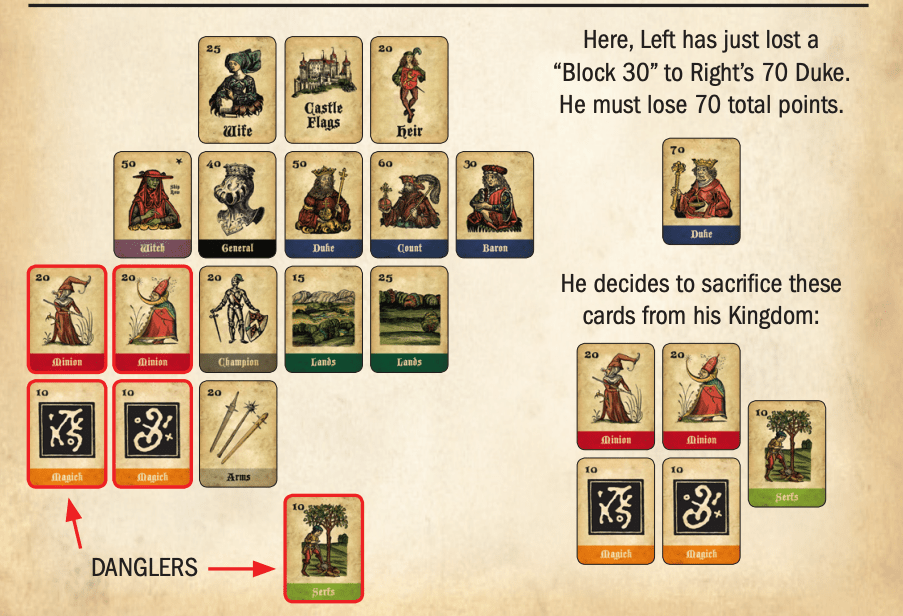
This is a lot of ways to say that the rule book resulted in a poor player experience. So bad, in fact, that I was never able to actually play the game.
A great example to follow
As a counter to a bad rule book, I would like to focus on what makes a great one so amazing. Star Wars: Rebellion is a much larger game, and yet the rules are easier to follow for so many reasons.
You can view the rulebook and the reference book via links at the bottom of this page on the publisher’s site.

As a counterpoint to the Castles rules, this rulebook starts where it should; with a thematic introduction and an overview of the game. No game is too big or too small to justify not having these. They set the tone for the game and bridge the gap between mechanics and theme. Without these, a game is just mechanical, and the experience is far less meaningful as a result. If a Star Wars game needs these elements, so does your rule book.
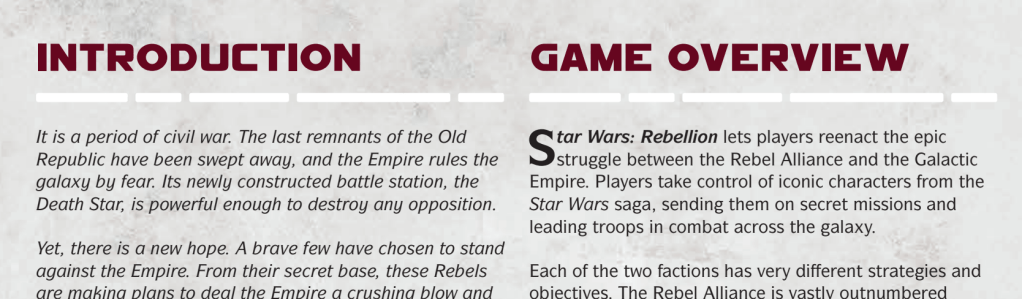
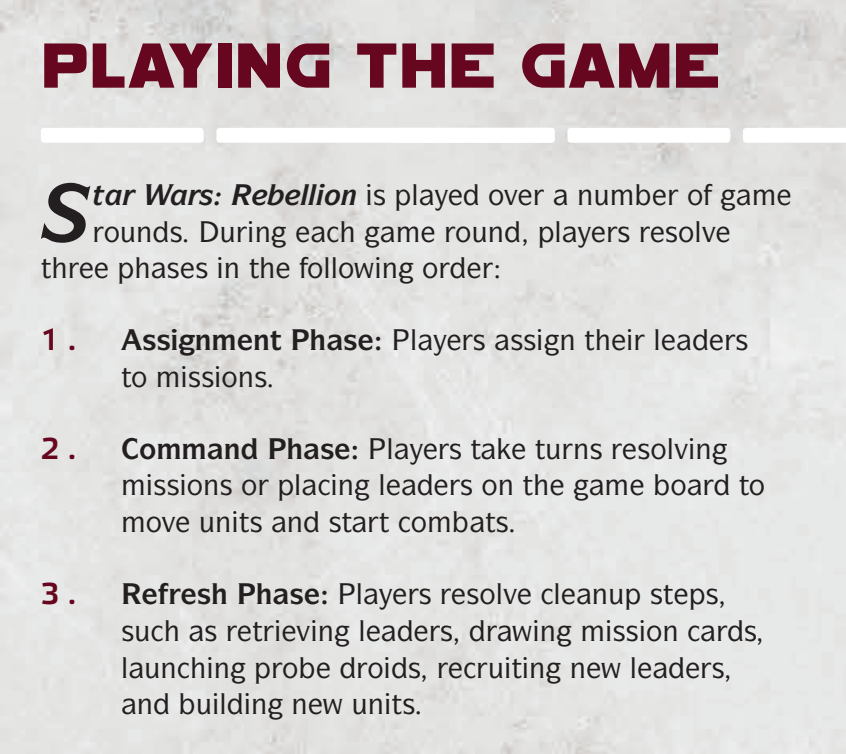
The book follows a logical progression from introduction to game overview, components inventory (which teaches the labels), and right into an overview of how a round works. Again, no game is too small to skip this. Without a high-level view of a round/turn, it’s very hard for players to form a mental model of how the game will work.
For a game as robust as Rebellion, this overview is remarkably concise and helpful:
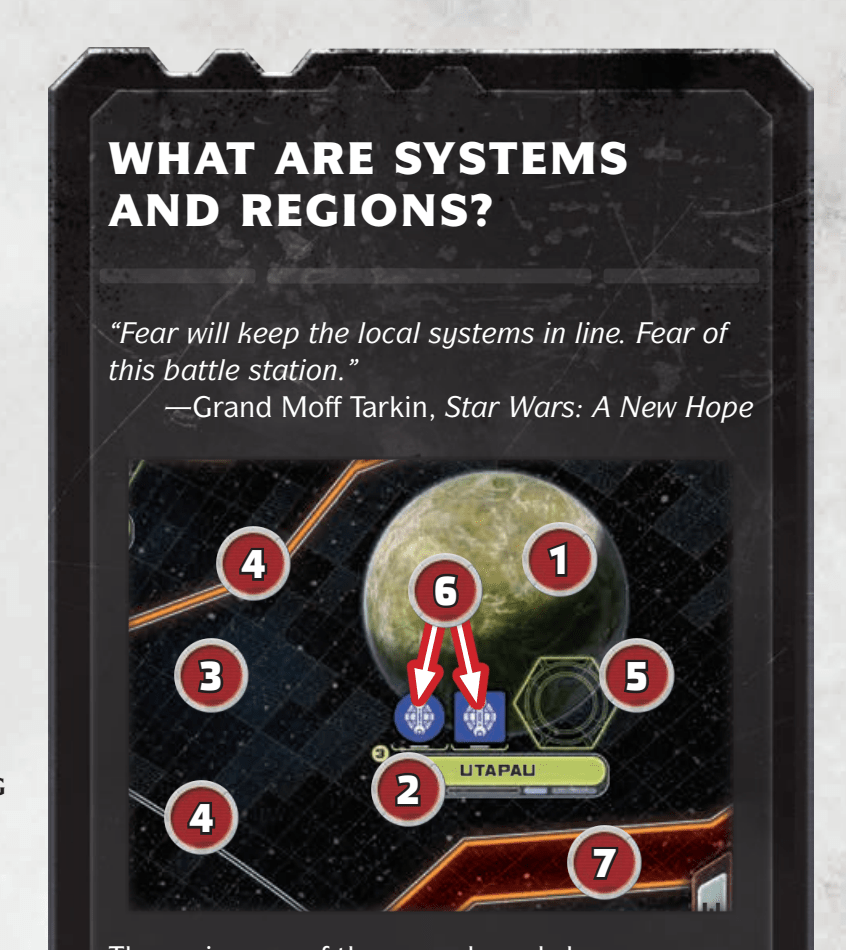
One of the most magical things about the book is that it includes sidebars such as the one below, in the context, where it is helpful. So when the rules first start talking about systems and regions, it includes an extra sidebar with visuals to explain it. In this way, the information just always feels like it’s where you need it. Interestingly, information like this is repeated in multiple contexts to ensure it’s easy to find and positioned where it’s needed. It’s just so well thought out!
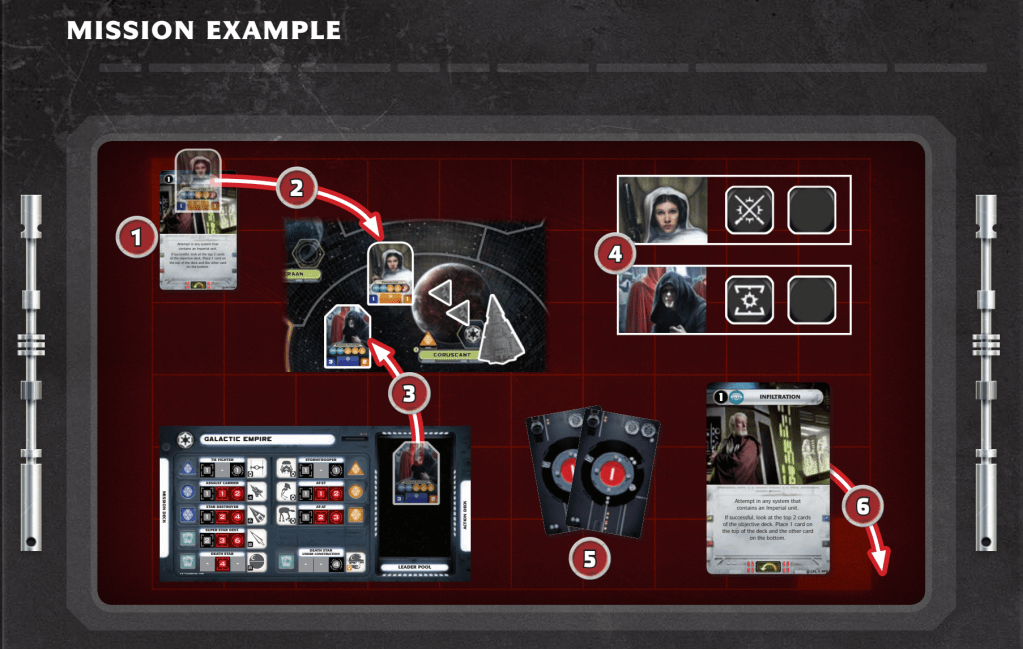
The book contains numerous examples to illustrate both basic and advanced concepts. The examples are not grouped into a single spot; they are included right after the given topic is presented. In this way, you can easily find an example of most concepts to help them make sense.
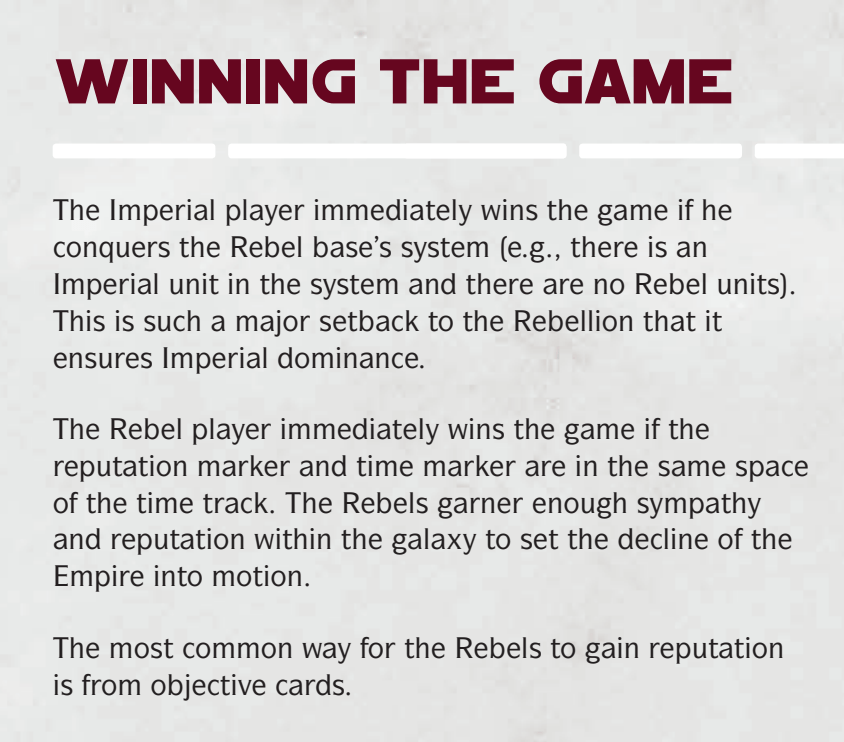
Another way this book stands out from that of Castles is that it clearly describes how each player can win the game.
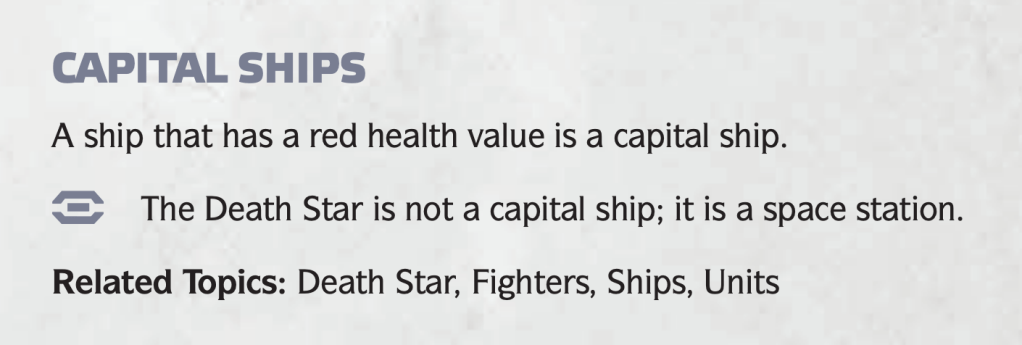
Finally, the game actually has 2 rule books. The first is the book that teaches you how to play. It’s structured and ordered to help you work through all the things. But in a game of this size, you frequently need to look up a term and see what it means. They could have done an index, but they went the extra mile and provided a whole second book that is an alphabetized glossary of terms.
I can recall playing my first game of Rebellion and coming across a card that said “Capital Ships.” I remember wondering what that meant exactly. Using the reference book, I quickly found an answer. Not every game can justify a second book like this, but again the publisher recognized the need and provided the tools to make playing this rather complex game as easy as possible. I think the game’s success is at least in part due to the elegance of the rules and the reference book.
Conclusion
Over the years, I have seen several lists of what should go in a rule book. I must admit there were times I thought some of it was unnecessary. But having reviewed the Castles rules again, and then comparing them to Rebellion, I get it. Each part of the rule book has a very real purpose, and the players’ experience is diminished when you leave out some portion of it.
